
About Elaine
I was in my twenties in 1972, when my husband and I bought 71 acres of neglected forest and field bordering the Finger Lakes National Forest. The house was so decrepit it made our mother’s cry. We worked on the property for 30 years and made it a beautiful rural home. I also worked as a nutritionist and exercise trainer while raising two sons with a husband who taught physics at Colgate University.
My beloved husband died of cancer in 2008. Before his death, he finished his third book requested by the Dalai Lama called Tibetan Buddhism and Modern Physics: Toward a Union of Love and Knowledge (Templeton Press). Reflecting on the power of his death and years of caregiving, I wrote Leaning into Love: A Spiritual Journey through Grief. My book won the IPPY (Independent Publisher Book Awards) Gold Medal in the category of Aging, Death & Dying in 2015
In 2024, I still live on the property Vic and I bought bordering a small National Forest and protected by a conservation easement with Finger Lakes Land Trust. I write about family and nature and post two blogs a month, while I deal with the challenges of aging and hearing loss. My passion is learning about and protecting Monarch butterflies and saving them from extinction.
To contact Elaine Mansfield directly, please send an email to [email protected].


Wild Nights:
Grief Dreams, Mythology, and the Inner Marriage
I clutch my covers and pull them over my pounding heart. My vagina pulses in a slower rhythm sending waves of heat into my womb. My body says, “Come to me, honey-man.” My vulva says, “I’m ready.”
I open my eyes and reach toward his side of the bed.
Empty.
It’s a dream. Another dream. Lost dreams, anxious dreams, longing dreams, wet erotic dreams. So many dreams since his last day.
I throw the covers off my sweating body and roll on my back. Slivers of daylight sneak in around closed shades. Time to get up. Time to face the truth.
My husband Vic is still dead.
In the dream, I’m at a banquet table, voraciously hungry. Dream Vic lies on his back on the floor beneath the table. He looks up into my eyes and smiles. He gasps for breath, like a runner at the end of a marathon, like a man dying of cancer. I touch his wrist and feel his erratic pulse. I lie down next to him and cover his face with gentle kisses. I kiss his mouth. He kisses me with the hunger of a healthy man. He’s dying, but love and desire are stronger than ever.
I lie in bed recalling every image, feeling my hunger, clinging to this surge of life a few minutes more. I want to remember each detail so I can write the dream in my journal. The night passions I record there stand in sharp contrast to my gray waking world.
Vic has been dead four months. Even if I wanted to forget, my dreams won’t let me. They remind me of my longing for the human love I can’t have in waking life
“I see him with you,” a friend says when I run into her at the grocery store. “I see him right behind you. He’s with you all the time.”
I swallow an urge to scream. My fingers close into fists. I sigh and take a deep breath. “What about his body?” I say. “I miss his body. I miss being held and rocked. I miss being caressed and kissed. There are no penetrating brown eyes in an apparition behind my back.” I could say no penetrating penis, too.
Without people like C.S. Lewis, I’d feel like a lunatic. He wrote, “Bereavement is not the truncation of married love, but one of its regular phases—like the honeymoon. What we want is to live our marriage well and faithfully through that phase too. If it hurts (and it certainly will) we accept the pains as a necessary part of this phase.” (Lewis, p. 41) Lewis understood that the marriage goes on even after one partner dies.
My body isn’t ready for a nunnery, but not any lover will do. I want the man under the banquet table. The man who once shared my marriage bed. My honey-man who is now my dream man.
In the earliest written poetry from Mesopotamia, the Goddess Inanna, Queen of Heaven and Earth, longs for her honey-man, too. In her youth, she searches for the perfect husband and chooses the shepherd Dumuzi, an earthy agricultural god.
As they prepare for the marriage banquet, the poetic language thickens with nature’s sensual pleasures. Rich cream. An erect cedar on the King’s lap. A field waiting to be planted. A banquet, the marriage bed, and the Goddess’s juicy response.
I (Inanna) poured out plants from my womb…
My honey-man, my honey-man sweetens me always.
My lord, the honey-man of the gods,
He is the one my womb loves best.
His hand is honey, his foot is honey,
He sweetens me always.
(Wolkstein and Kramer, p. 38)
Lying alone in my marriage bed, my heart beat slows and my body cools. I wrap my arms around a pillow and pull a sheet over me—over us—and rest in the images a few more minutes. I smell my own body in the warm blankets and long for Vic’s embrace.
Inanna opened the door for him.
Inside the house she shone before him
Like the light of the moon.
Dumuzi looked at her joyously.
He pressed his neck close against hers.
He kissed her.
…Then plow my vulva, man of my heart!
Plow my vulva.
(Wolkstein and Kramer, p. 36-37)
After a long and fertile marriage, I no longer have the outer man who brought a sense of balance to my life. Somehow, I don’t know how, I must find the sacred marriage within.
***
Looking for clues about the inner marriage, I returned to the first dream I had as a widow. Eight days after Vic’s death, I had this dream: A giant man with spring green skin and red foliage hair sits in a porcelain bathtub. He is the Green Man. I will live in his wooden house for a year. My room is small and plain, like a nun’s cell.
This dream gave the first instructions for my post-marriage life. Live in the house of the Green Man which I interpreted as stay close to nature. Live like a nun. This was also the first glimpse of a new inner masculine, one related to the part of Vic that loved and tended our land, but a mythical archetypal figure rather than a personal one. At the time, I knew little about the rich history of the Green Man in Northern Europe but soon learned that the dream details matched this Nature God of Life, Death, and Rebirth.
As I read about the Green Man, I felt protected and guided in the solitary life awaiting me. I knew I would be OK.
The Green Man dream also connected me to Inanna’s consort, the shepherd Dumuzi. I knew Inanna’s story well. The first written record was around 2500 BCE, although, according to artifacts, her worship began much earlier. Instead of a warrior, she chose a shepherd and agricultural god as her lover, a cyclic living and dying god like the Green Man.
In a tiny carved cuneiform image from 2000 BCE (Wolkstein and Kramer, p. 43), a couple lies facing each other in a decorated bed. Scholars interpret this as an image of the Sacred Marriage of Inanna and Dumuzi. In the ancient world, the eroticism of the Goddess was celebrated and honored as the Giver of Life.
In this 4000-year-old image, Inanna and Dumuzi are the same size. She cups her full breast for her lover—the sacred milk needed to nurture the seed he will implant. He touches her belly with tenderness and wraps his hand around her neck to draw her close. She wraps her right hand around his waist to pull him in. They gaze into each other’s eyes with unguarded intimacy. A text from that time called “The Courtship of Inanna and Dumizi” says:
He put his hand in her hand.
He put his hand to her heart.
Sweet is the sleep of hand-to-hand.
Sweeter still the sleep of heart to heart.
(Wolkstein and Kramer, p. 43)
After Vic’s death, I ached for that intimacy, hand in hand and heart to heart. I welcomed even the anxious and sorrowful dreams, but treasured the dreams of us as lovers. Each came as a surprising gift, since we rarely made love during his last sick years.
What was the unconscious trying to tell me with the insistent repetition of erotic dreams? I didn’t fully understand. I only knew that the dreams made my body pulse with desire.
The first sensual dream came six weeks after the Green Man’s appearance:
In the dream, I said to Vic, “I can’t stay with you much longer. You have to leave.” He looks at me with wet sad eyes. “I can’t be married to a dead person,” I say. I sob and cling to him, but then pull away. “Don’t you know how much I love you? But you can’t stay. I can’t be married to a dead man.”
Our dream embrace was desperate, hot with raw grief, face-to-face like Inanna and Dumuzi. I opened my heart to dream Vic as I had in life. As I wept, he seemed to grieve for me, but not himself. Dream Vic knew that I was asking for what couldn’t be.
Like many widowed people, I longed for my husband the way the Goddess Inanna longed for her honey-man. Later in the myth, when Dumuzi was exiled to the Great Below for half the year, Inanna’s love longing became grief longing:
Gone is my husband, my sweet husband.
Gone is my love, my sweet love.
My beloved has been taken from the city…
My beloved bridegroom has been taken from me
Before I could wrap him with a proper shroud.”
(Wolkstein and Kramer, p. 86)
In those early months, I thought I would move past, get around, work through, and recover from grief quickly. I’d done years of psychological work and had grieved with my husband before his death, so I was sure the unrelenting heartache and tears would soften their grip. Soon.
I was wrong.
Vic didn’t leave. Instead, I had to learn what it meant to be married to a dead man.
After another series of searching, lost, desperate dreams, a new lover dream emerged: Vic is in bed with me. We’re naked. His head rests against my diaphragm beneath my breasts and against my belly. I hold his head in my hands before touching the rest of his body in the dark. He sleeps deeply. I don’t know when he arrived, but I’m relieved to find him here, warm and touching me. We haven’t slept together for a long time.
I awoke having an orgasm, but the images told me a subtle shift was taking place. I was comfortable with Vic’s presence. There was no mention of needing him to leave. He slept, but I was awake, conscious of the masculine energies close to me. His hand rested on my upper arm, above my breast. The inner masculine was with me, in my hands, against my belly.
A month later, in another dream, I’m sleeping. I hear Vic’s quiet voice say, “Move over.” He’s stands by the bed and wants in. I open the blankets for him. He lies down facing me.
I invited him into our marriage bed—the bed that belonged to my grandparents before it was passed down to me. The inner masculine and feminine were together, awake and conscious, face-to-face like Inanna and Dumuzi in their marriage bed.
Over the next months, more erotic dreams arrived with a common theme: Dream Vic was both dead and alive.
In one of these dreams, Vic pulls me down on a big couch, spoons me from behind, and kisses the back of my neck. I tell him I’m confused. I know what date it is and he shouldn’t be alive now. But he’s here, holding me.
Dream Vic was behind me. I couldn’t see his body. My emerging inner relationship with him remained unconscious and hidden as I grappled with the opposites of outwardly dead but still alive in me.
A few months later, the Wise Woman archetype arrived in a healing image of Marion Woodman, a Jungian analyst who had been my guide and revered teacher of feminine psychology and spirituality since the 1980s.
In that dream, Vic lies face down on a massage table. I rub his back, slowly and tenderly. I know he’s dying. Marion Woodman sits at the head of the massage table with her hand resting on the crown of Vic’s head. As my hands move over his back, Marion’s right hand stays still, cupping the top of Vic’s head in a gesture of blessing.
The Wise Feminine had come to bless the ailing animus. In life, Marion taught with Vic and knew him from workshops we attended. During his illness and after his death, she wrote me letters of loving support. In this dream, Marion, calm and regal, was the archetypal wise woman silently witnessing and blessing the dying masculine. As Crone, her hands held both life and death with equanimity.
I remembered Marion’s hands as she held mine, one hand over the other, in a photo on my altar. I also remembered a photo taken by a close friend on Vic’s dying day when I stood next to Vic’s bed and held the crown of his head in the same gesture in which Marion held him in my dream. As he struggled to leave his body, I had focused my energy on his crown chakra where the life force is said to exit the body at death. Death was the only way to release him from suffering. I wanted to help him go.
The Inanna text said it this way:
Inanna placed Dumuzi in the hands of the eternal (Wolkstein and Kramer, p. 89).
Like Inanna, I had placed my husband in the hands of the eternal. I couldn’t save him, much as I wanted to, but I could stand with him as priestess. Dream Marion’s gesture reminded me that I had taken this role for Vic. Unconsciously, I had blessed and released the wounded masculine into death.
Just after the first anniversary of Vic’s death, another sensual dream arrived: Vic takes me in his arms and holds me close. I feel his tender comfort and weep with hard wrenching sobs while he consoles me. I know he’s dead and will not hold me like this again. He feels warm, firm, and reassuring.
I wept for Vic the way the Goddess Inanna wept for her king Dumuzi:
“…I can no longer bring him food.
I can no longer bring him drink.”
The jackal lies down in his bed
The raven dwells in his sheepfold.
You ask me about his reed pipe?
The wind must play it for him.
You ask me about his sweet songs?
The wind must sing them for him.”
(Wolkstein and Kramer, p. 86)
My lover was dead in life, but my psyche still used his trusted image for the positive inner masculine. My dream animus was tender, but the erotic charge had faded. He was dead and “in the hands of the eternal,” although he still lived in me.
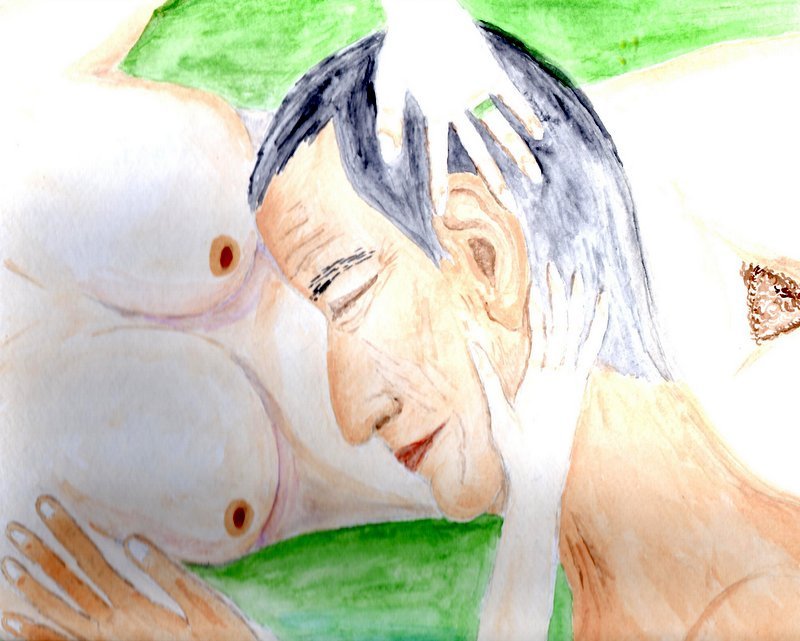
Sixteen months after Vic’s death, I stand at the kitchen sink naked. Vic puts his arms around me and speaks softly in my right ear. He whispers sweetly. I hug him. He’s short and small rather than muscular the way he was in life. His body is the same size as mine. We hold each other and sway back and forth. I say softly, “We have to remember how precious this is. I know what it’s like to be without it.”
My tumultuous emotions had softened into quiet surrender. I awoke from this dream filled with gratitude. Our equal body sizes reminded of Inanna and Dumuzi in their marriage bed. I also remembered the balance between masculine and feminine symbolized by the equal sizes of the King and Queen in the alchemical plates in C.G. Jung’s Psychology of the Transference. C.G. Jung wrote about the inner marriage or coniunction:
The unrelated human being lacks wholeness, for he cannot achieve wholeness only through the soul, and the soul cannot exist without its other side, which is always found in a “You.” Wholeness is a combination of I and You, and these show themselves to be parts of a transcendent unity whose nature can only be grasped symbolically, as in the symbols of the rotundum, the rose, the wheel or the coniunctio Solis et Lunae (the mystical marriage of the sun and moon). (Jung, p. 82-83)
I’d spent eighteen months exploring grief dreams. I’d done active imagination and tended my sorrow with frequent rituals at the site where Vic’s ashes were buried. I’d worked with a Jungian therapist and painted my most powerful dreams. I’d written about the last years of our marriage and Vic’s death, stories that later became the backbones of a book. Although there were many tears still to shed, the projection I’d placed on Vic for over forty years had been transformed and returned to me.
Grief had fueled my search for a new image of wholeness. Jungian thought and mythology provided the guiding ideas. Sensual dream images led me to explore the Green Man or Living-Dying God, the mythological marriage of Inanna and Dumuzi, the blessing of the Crone, and the transformation of the animus from outer husband to inner partner. The Divine Marriage of masculine and feminine was alive within me.
“If you want to hold the beautiful one,
Hold yourself to yourself.
When you kiss the Beloved, touch your own lips with your own fingers.
The beauty of every woman and every man is your own beauty.” (Rumi, p. 15)
***
This essay won the writing competition sponsored by Jung in the Heartland, October 2017.
References
Anderson, William. Green Man: The Archetype of our Oneness with the Earth. London and San Francisco: HarperCollins, 1990.
Jung, C.G. The Psychology of the Transference. London: Routledge, 1969.
Lewis, C.S. A Grief Observed. New York, NY: Faber & Faber, 1961.
Rumi, Jalal al-Din. “Give Yourself a Kiss,” translated by Coleman Barks, Like This: 34 Verses. Athens, GA: Maypop, 1990.
Wolkstein, Diane and Samuel Noah Kramer. Inanna, Queen of Heaven and Earth: Her Stories and Hymns from Sumer. New York, NY: Harper Perennial Edition, 1983.
***